
AI Job Tracker: from scattered listings to useful signals
A public Python pipeline that gathers job listings, evaluates fit with AI and sends candidates a clearer next action through Telegram.
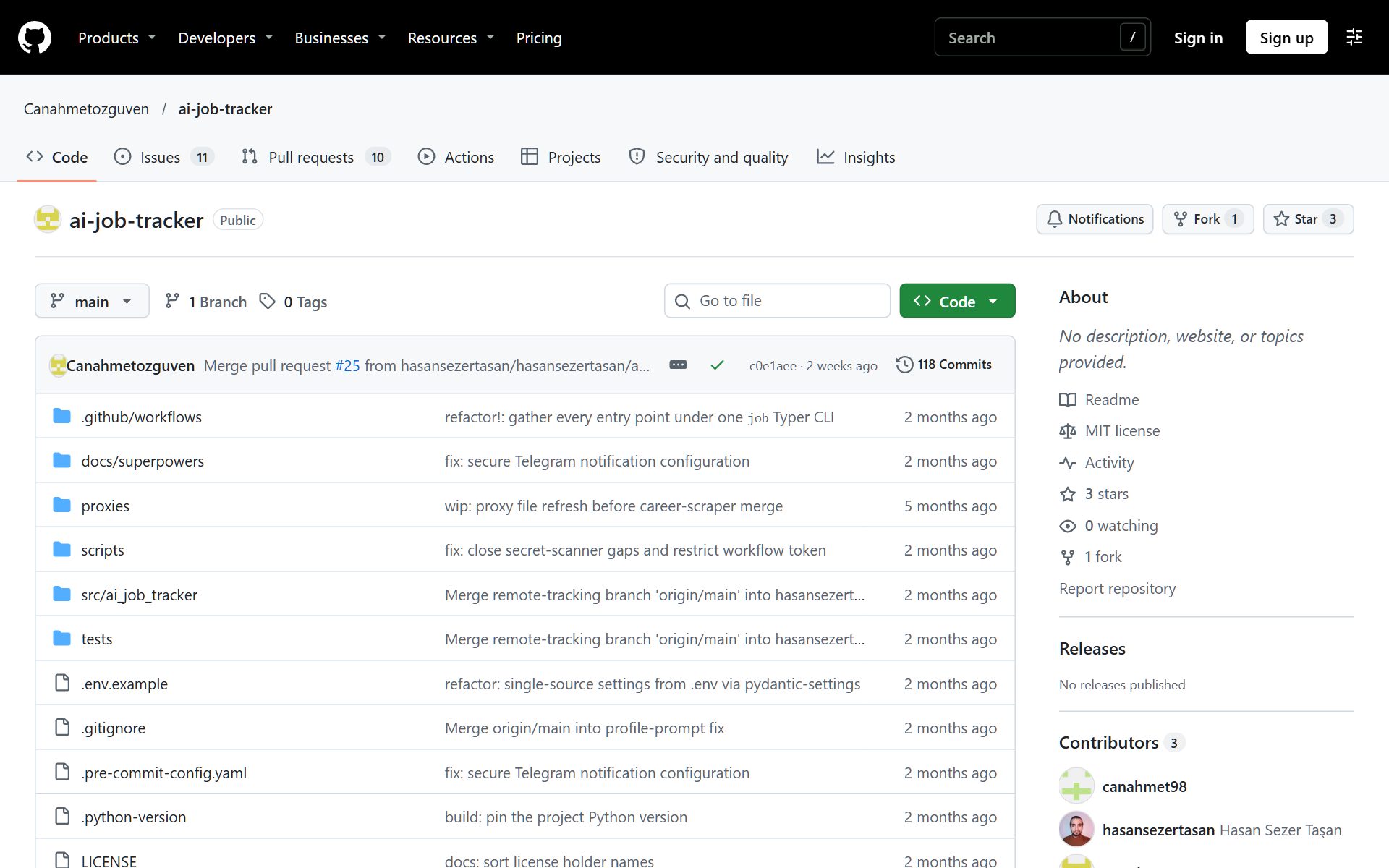
A job search has a data engineering problem hiding inside it: duplicated listings, unpredictable sources and a constant need to decide what deserves attention.
Turn pages into structured events
The repository starts with scraping through JobSpy and LinkedIn-related sources, producing structured job records that downstream code can process. It includes freshness windows, deduplication and scheduled runs—small details that matter much more over time than a polished demonstration.
The aim is not to scrape everything. It is to collect relevant opportunities consistently enough that analysis has something meaningful to work with. Source availability and access rules still need to be respected.
Analysis should answer a question
The next step compares job requirements with a candidate profile using AI and generates an actionable fit signal. That is more useful than simply dumping another hundred links into a spreadsheet.
The pipeline then sends notifications through Telegram. This completes the loop from collection to interpretation to delivery, with configurable execution from the command line.
What this project demonstrates
The interesting engineering here is not a single model call. It is the reliability of the complete chain: acquisition, normalization, filtering, evaluation, retries and notification.
The public GitHub repository documents setup and workflow details. It is an independent open-source project, not a commercial client deployment.
What the public repository actually contains
The published README documents a CLI-based workflow: scrape job listings, write JSONL records, evaluate fit with an AI model and send results to Telegram. The source separates scraping, analysis, scheduling and notification modules. That separation is useful because changing a source or a model should not require rewriting the entire pipeline.
uv run job scrape --query "data scientist" --location "Turkey" --hours 1
uv run job analyze --jobs jobs.jsonl --hours 1
uv run job daily
These are documented commands from the public README, not fabricated execution output. Always check each source’s access terms before automating collection.
Architecture: from public listings to one useful notification
The repository makes the individual responsibilities visible. Collection and filtering happen before model evaluation; notifications are the final delivery channel rather than the sole output of the system.
Workflow: 01 / COLLECT → JobSpy + sources → Freshness · duplicates → 02 / STRUCTURE → JSONL records → Portable job data → 03 / ASSESS → Gemini analysis → Profile fit · recommendation → 04 / NOTIFY → Telegram → Actionable summaries
Where the difficult parts actually are
Source variability: job listings change shape and availability. Data extraction needs explicit source validation and sensible failure handling; a single successful scrape is not evidence of reliable collection.
Deduplication and recency: repeatedly finding the same vacancy is not a useful outcome. The public README documents time windows and deduplication, so this is a separate concern from model relevance scoring.
Model judgment: a fit score is an aid to prioritization, not a hiring decision. Changing the candidate profile, job description or model can affect the recommendation. A user should still verify important claims before applying.
Operations: the repo documents scheduled execution, retry behavior and configurable notification. A deployment needs monitoring, working credentials and explicit attention to the terms of every source used.
These choices illustrate the difference between a model demo and an end-to-end automation: the pipeline must keep making sense when a source changes, a model response fails, or an alert should not be sent.
Links and source material
Written by Can Ahmet Özgüven.
Next note Inside CHUVGA: from student signals to coordinated follow-up