
Synapse Notes: making on-device AI useful for everyday thinking
A mobile notes project exploring how local inference, retrieval and a thoughtful interface can serve ideas without turning every note into a cloud request.
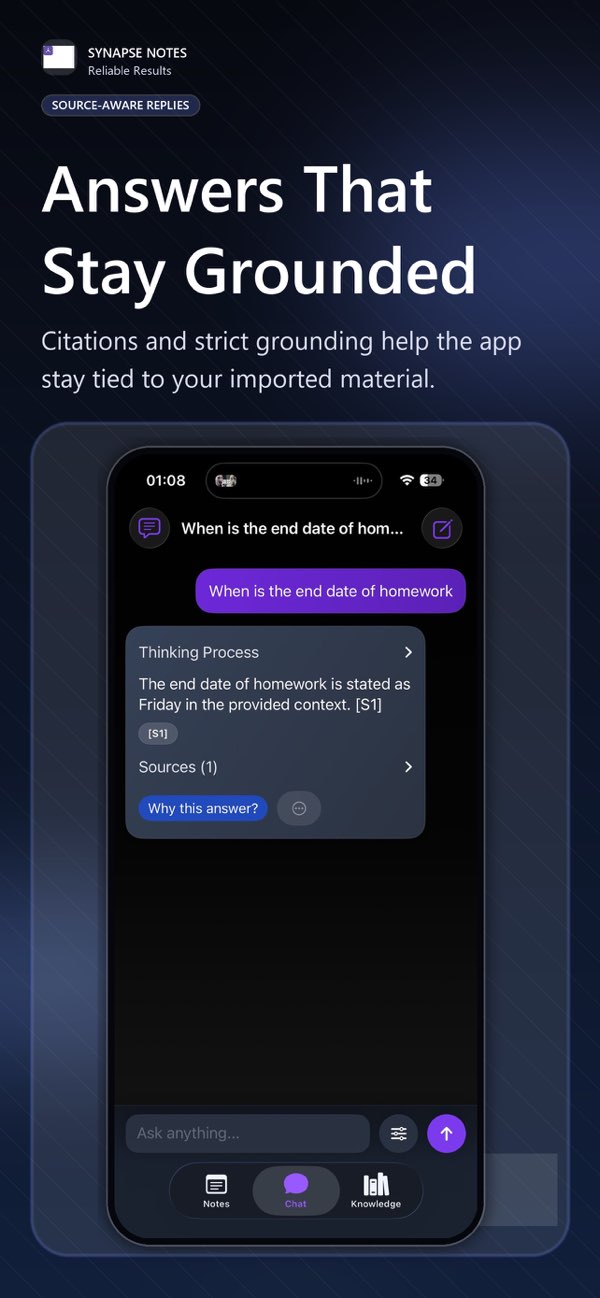
Synapse Notes began with a fairly ordinary question: what if the intelligence around your notes lived on your device rather than behind another web API?
The problem behind the interface
Most note-taking apps are good at collecting text. They are less good at helping you find the thought that mattered three weeks ago, make connections across notes or ask useful questions about your own material.
The natural AI solution is to send everything to a hosted model. That is a valid choice for many products, but it changes the privacy story, operational dependencies and the experience when the network is unreliable. We wanted to explore a more local approach.
Local models change the engineering
The Android implementation explores on-device inference through llama.cpp, with hardware-aware execution paths and retrieval over local notes. That means the product has to respect memory, heat, latency and varying device capabilities in a way that server-based prototypes can ignore.
Retrieval matters as much as generation. A helpful answer should be grounded in what the user actually wrote, not a plausible guess. We treat search, context selection and clear failure behavior as essential pieces of the experience.
What we are learning
A product built around local AI has to earn its place as a notes app first. Capture must be fast, reading must remain pleasant, and AI must improve a real task instead of taking over the whole interface.
We are still exploring these trade-offs. The public repositories and store listings below are the concrete artifacts; this article describes our design direction, not benchmark results or performance guarantees.
Why on-device matters
The published app listings describe local AI chat, PDF and image import, and optional Google Drive backups. Keeping primary inference on the device changes the privacy trade-off, but it also raises practical questions around model size, responsiveness, offline behavior and device-specific acceleration. Those decisions need to be validated against the target hardware rather than advertised as universal performance guarantees.
What people can verify today
Synapse Notes is publicly listed on the App Store and Google Play. The iOS listing describes on-device language-model features, conversations with notes, document imports with OCR and optional Google Drive backup. It also states that core use does not require an account. These are published product descriptions, not independently measured performance or security guarantees.
Inspect the live iOS listing ↗
Why local AI changes the product decisions
Putting inference on the device changes more than where requests are processed. Model downloads, storage pressure, energy use, hardware compatibility, app permissions and the experience of first-time setup become central product questions.
Privacy claims also need precision. On-device computation reduces reliance on remote inference, but optional backups and imported documents still require careful handling and transparent user choices. The meaningful engineering story is how those boundaries appear in actual behavior, not simply the phrase “local AI.”
The next published version of this note should include approved application screenshots and a measured explanation of the specific model/backend decisions used in the released builds.
Links and source material
Written by Can Ahmet Özgüven.
Next note AI Job Tracker: from scattered listings to useful signals